
Tierce de Picardie
The Picardy Cadence

“TIERCE of PICARDY. The musicians call by this term, thro’ pleasantry, the major tierce [third] given, instead of the minor, to the final of a piece, composed in minor mode. As the major perfect concord is more harmonious than the minor, it was formerly a law to finish on the first; but this final, tho' harmonious, handsome thing grating which caused it to be forsaken. We always finish now by the concord which is suitable to the mode of the piece, unless when we would pass from minor to major, for then the final of the first mode bears the major third elegantly to announce the second. It was called tierce of Picardy, because the use of this final continued longest in the church music, and consequently, in Picardy, where they have music in a great number of Cathedrals and other Churches.”
— Jean-Jacques Rousseau, Dictionary of Music, 1768
[See the English translation of Rousseau’s Dictionary of Music]

Picardy’s Third
No one truly knows why this musical device bears the name of Picardy. While there are several theories, the lack of concrete, historical evidence leaves its origin open to debate. Jean-Jacques Rousseau, in the above excerpt, provides the first historical recording of the musical device being referred to as the Tierce of Picardy, or Picardy’s Third, in his Dictionary of Music published in 1768. In this work, he may have popularized this, perhaps colloquial, terminology for the musical device.
So, what exactly is this Tierce of Picardy?
This little musical device had existed for quite some time prior to Rousseau’s mention of it in his compendium of music. In essence, this musical device is a turn of phrase that is used in pieces that begin with a minor key and resolve to the major. A major chord is a three-note chord consisting of the root note, the major third, and the perfect fifth. This type of chord conveys a sense of stability and resolution, contrasting with the more somber quality of a minor chord. There are numerous popular examples of this devices use. Take Bach’s Jesu, meine Freude (Jesus, My Joy), BWV 81.7, mm. 12–13, for example:
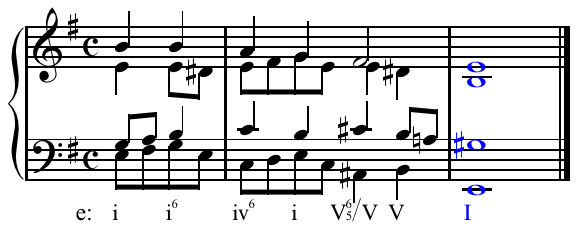
Note the final resolution in blue is the major. Bach is in good company, as many prevalent composers, including the likes of Mozart, Beethoven, and Handel have all leveraged this device for turning the phrase to the major in resolution for a minor piece.
This musical device and preference had existed for quite some time, originating in the late medieval/early Renaissance period, likely during the time when the church was heavily involved in the pursuit and composition of music as a source of conveying the divine.
Adapting theories of music
During the Counter-Reformation, the Catholic Church’s approach to sacred music began to evolve, aiming for greater clarity and emotional resonance to connect more directly with congregations. The Council of Trent (1545-1563) emphasized the importance of intelligible and impactful music, which could have encouraged composers to use techniques like the Picardy Third. By concluding minor-keyed pieces with a major chord, composers may have been symbolically reflecting themes of redemption and transcendence, aligning with the Church’s desire to convey a message of hope.
Alongside these religious shifts, the broader Renaissance focus on Humanism encouraged composers to explore new harmonic choices that expressed a variety of emotions. In this environment, the Picardy Third became a characteristic feature in a variety of music, creating a tonal resolution that gently shifts from somber to uplifting. This stylistic choice likely resonated with audiences, adding depth to their experience of music ending somber passages with an uplifting and hopeful tone.
Lachrimae (Flow my tears), a popular lute piece by John Dowland leverages the Picardy Third throughout the piece, shifting the cadences of various sections to the major:
Origin of ‘Picardy’
As mentioned above, the origin of the nomenclature for this musical device is shrouded in mystery. While many theories have been posited, none have been able to substantially back up their claim with historical fact. Some popular theories include:
Regional Origin Theory: Some scholars suggest that the practice of ending minor-key compositions on a major chord originated in the Picardy region of northern France. While this is a widely accepted theory, there isn’t concrete evidence directly linking the Picardy region to the origin of this technique. However, the association with the term “Picardy” may have emerged because this area was influential in musical and cultural development during the Renaissance.
Linguistic Theory: Another theory claims that the term comes from the old French word picart, meaning “sharp” or “pointed.” In this interpretation, the Picardy Third refers to the raised third in the final major chord of a piece in a minor key. This theory suggests that the “sharp” or “raised” nature of the third interval became a descriptive term for the musical technique rather than a direct reference to a geographical location.
With the musical device existing for quite some time, used throughout the European continent by composers in the Renaissance and earlier, I find it hard to believe this association can be traced to any singular place of origin, including Picardy. I believe, much like Rousseau states in his section, that the name may have colloquially become associated with the Picardy region in the time of Rousseau—as this musical device began to wane in dominance towards the later Baroque.It may have been a holdover in churches and church music that still held to this practice in Picardy that established the region's famous association.
The Linguistic Theory seems less convincing than the first argument. The etymologic jump from picart to Picardy isn't one I can follow. While my lack of understanding of French may hinder my ability to draw the same distinction, I believe Rousseau's report is inclined to support the regional origin story.
Another tie to Picardy
Strangely, after some research for this post, I've come to find another interesting historical fact related to Picardy. There is a popular French folk tune known by the same name. The Picardy hymn (or tune), was a French song/chanson dating from at least the 17th century that has been used as the basis of several popular hymns today.
Oddly enough, this song’s tune does not resolve to a major like the Picardy Third so boldly established. Had it originated after the influence of the Church’s desire for major key resolutions began to wane? Most songs sung to this tune are religious in nature, so it is quite interesting to see there is no resolution to the major given the subject matter.
The hymn Let All Mortal Flesh Keep Silent is an English hymn that is sung to the original Picardy tune. The setting of the hymn to the Picardy tune was done in 1905. There are other French pieces that use the same tune, for example, Jésus Christ s'habille en pauvre. You can find recordings of both pieces below:
In conclusion, the Picardy Third stands as a fascinating musical device that has captivated composers and audiences for centuries. While its precise origins remain shrouded in mystery, the Picardy Third's ability to create a sense of resolution and emotional transformation has made it a valuable tool in the composer's toolkit.
